14 Nov 2026
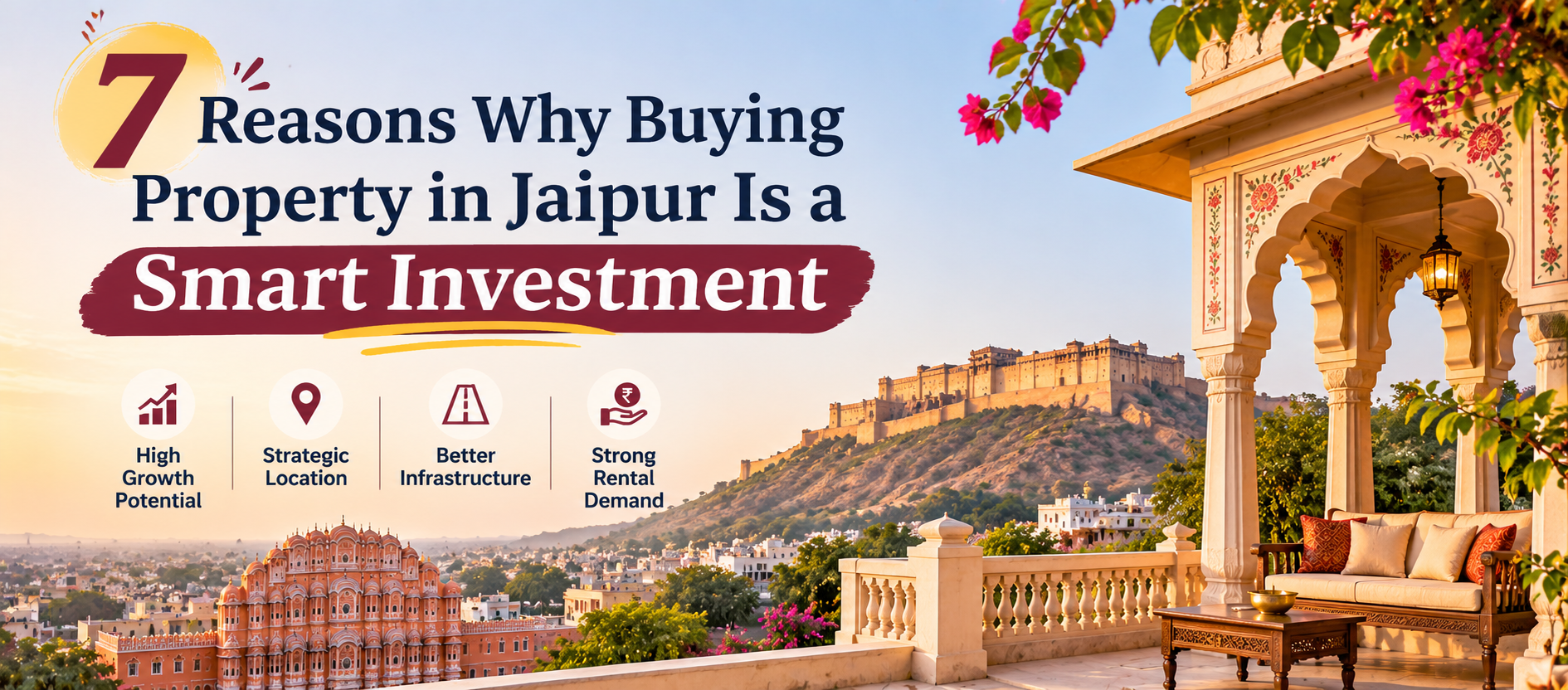
7 Reasons Why Buying Property in Jaipur Is a Smart Investment
Jaipur, the capital of Rajasthan, is known for its heritage, tourism, education and growing business activity. Over the years, the city has expanded beyond its traditional centre, with residential neighbourhoods, commercial areas and industrial zones developing across different parts of the Jaipur region. This growth has made property investment in Jaipur an option worth studying for homebuyers as well as long-term investors.
Buying a property in Jaipur is a major financial decision. It should not be based only on attractive advertisements or the expectation that prices will rise. A good investment depends on the location, legal status, construction quality, connectivity, total cost and the buyer’s financial plan. Jaipur offers several reasons to consider real estate, but each property must be checked on its own merits.
We explain seven practical reasons why buying property in Jaipur may be a smart decision, what buyers should examine before investing, and how to choose a property that fits their goals.
1. Jaipur Is Growing as a Residential and Economic Centre
Jaipur is more than a tourist destination. It is also an administrative, educational, healthcare, retail and business centre for Rajasthan. Government offices, universities, hospitals, hotels, retail businesses, manufacturing units and service companies create a wide range of reasons for people to live and work in the city.
As employment and education opportunities develop, people may move to Jaipur from smaller towns and nearby districts. This can support demand for homes in locations that offer access to workplaces, schools, hospitals and daily conveniences. Families may look for apartments or independent homes, while business owners may consider commercial premises or land for future use.
For an investor, the important point is to understand the demand in the exact micro-market. A growing city does not mean every locality or project will perform equally. Study nearby employment centres, occupied housing, infrastructure, available supply and the type of buyers or tenants likely to need the property.
2. Infrastructure Development Can Improve Connectivity
Connectivity has a direct influence on how convenient a property is for residents, employees and customers. Jaipur has an operational metro corridor connecting Mansarovar with the walled-city area. In April 2026, the Union Cabinet approved Jaipur Metro Phase 2: a proposed 41-kilometre north–south corridor with 36 stations, planned to connect activity areas including Sitapura, the airport area, Tonk Road, SMS Hospital, Ambabari and Todi Mod. The official announcement gives a target completion of September 2031.
Road upgrades also matter. In March 2026, the Ministry of Road Transport and Highways announced a contract for flyovers and underpasses at the Jaipur Bypass junction on NH-48, an important connection for traffic moving between Delhi, Ajmer and parts of Jaipur. Such projects are intended to improve movement, although construction timelines and the actual effect on nearby travel patterns should be monitored.
Better transport can make some locations more accessible and may increase their appeal to residents and businesses. However, buyers should distinguish between operational infrastructure, work under construction and projects that are only proposed. Do not pay a premium solely because a future metro station or road project has been advertised. Check the official route, station location, approvals and realistic completion schedule.
3. A Range of Localities Offers Different Investment Choices
Jaipur has multiple property markets rather than one uniform market. Established areas may offer existing social infrastructure and a more settled neighbourhood. Developing areas may provide newer layouts or different price points, but they can also involve longer commutes or infrastructure that is still being completed.
Localities such as Mansarovar, Vaishali Nagar, Jagatpura, Jhotwara, Sanganer, Tonk Road and areas around Sitapura are often considered by buyers for different reasons. Their suitability depends on the property type, budget, work location, road access, civic services and current supply. For example, a family may prioritise schools and hospitals, while a business buyer may focus on access to industrial areas, highways, logistics routes or customer traffic.
Before choosing a locality, visit it at different times of the day. Check road width, traffic, public transport, water supply, drainage, street lighting, nearby construction and access to essential services. Compare similar properties in the same micro-market rather than comparing a developing location with a premium established area.
4. Residential Property Can Meet Both Living and Long-Term Goals
Jaipur offers options such as apartments, independent houses, villas and plotted developments. This variety allows buyers to match a property to their stage of life and financial capacity. A first-time homebuyer may prefer a manageable apartment near work or family support. A larger household may need more space, parking and access to schools. Someone planning to build later may consider a legally approved residential plot.
A residential property can serve two purposes: it can provide a place to live and may also hold long-term value. Some owners may later rent it out if they relocate or purchase another home. Rental potential, however, depends on tenant demand, furnishing, maintenance, location, building condition and the rent achievable in that area.
Work out the full cost before deciding. Include the basic price, stamp duty, registration, brokerage if applicable, GST where applicable, parking or club charges, maintenance deposits, interiors, loan interest and ongoing upkeep. Compare the total cost with your income, savings and emergency fund. A property is not affordable simply because the booking amount is within reach.
5. Commercial and Industrial Opportunities Support Business Needs
Jaipur’s economy includes retail, hospitality, education, healthcare, manufacturing, warehousing, trade and professional services. These activities create demand for different kinds of real estate, including shops, offices, commercial plots, industrial land and warehouses. For entrepreneurs and businesses, owning suitable premises may provide control over the space and reduce dependence on changing rental arrangements.
Commercial and industrial property requires a different assessment from residential property. Buyers should study permitted land use, access for customers and goods vehicles, loading and unloading facilities, power and water availability, fire-safety requirements, building permissions and the nature of surrounding businesses. A site that looks attractive may not be suitable for a particular activity if its zoning or access does not support that use.
Investors should also consider vacancy risk, tenant quality, lease terms, fit-out costs and the time it may take to find a tenant. Commercial property can offer income potential, but it may be less liquid than a residential unit and can remain vacant for periods. Professional legal and technical checks are especially important.
6. Jaipur’s Lifestyle and Education Ecosystem Attracts Residents
Quality of life is an important part of a property decision. Jaipur has schools, colleges, universities, hospitals, shopping centres, restaurants, sports facilities and cultural attractions. Its heritage sites and tourism economy also support hospitality and service businesses. For many households, the appeal lies in having access to urban facilities while living in a city with a distinct cultural identity.
Families often shortlist neighbourhoods based on the time required to reach schools, healthcare, workplaces and relatives. Students and working professionals may prefer locations with public transport, affordable food options and access to education or employment hubs. These everyday needs can influence the long-term usability of a home and the pool of potential tenants.
Do not judge a neighbourhood only by its distance from a landmark. Check actual travel time during peak hours, the quality of connecting roads and whether essential services are operational. A property that supports daily life is generally more useful than one chosen only for a prestigious pin code.
7. Property Can Diversify a Long-Term Investment Portfolio
Some investors consider real estate as one part of a wider investment portfolio. Unlike shares or mutual funds, property is a physical asset that may be used, leased or developed, subject to legal permissions. This tangible nature appeals to buyers who want exposure to a different asset class and who have a long investment horizon.
However, property is not a guaranteed or risk-free investment. Prices can remain flat or fall, rental income can be interrupted, repairs can be expensive and selling may take time. Real estate also involves substantial upfront costs and is difficult to divide into small amounts. Buyers should avoid using all their savings for a single asset and should maintain adequate liquidity for emergencies.
Compare a property’s expected net rental income and likely holding costs with other available investment choices. Use conservative assumptions rather than relying on promised appreciation. If you are borrowing, test whether you can continue paying the EMI if your income changes or the property remains vacant. Independent financial advice may be useful for a large purchase.
How to Choose the Best Property in Jaipur
The Best property is not necessarily the most expensive or the one with the biggest advertisement. It is the one that meets your purpose, is legally sound, fits your budget and has realistic demand. Use the following checks before paying a booking amount:
· Define your goal: self-use, rental income, business use, land holding or long-term investment.
· Set a complete budget that includes taxes, registration, loan costs, interiors and maintenance.
· Compare at least three properties in the same locality and verify recent comparable transactions where possible.
· Check the title chain, ownership, encumbrances, land-use classification, approved layout and building permissions.
· Search the project and promoter on the official Rajasthan RERA portal where RERA registration is applicable.
· Verify JDA or other competent-authority approvals directly through official records; do not rely only on brochures.
· Inspect construction quality, access roads, water, drainage, electricity, parking and common facilities.
· Read the agreement carefully, including payment milestones, possession terms, cancellation conditions and promised amenities.
· Ask an independent property lawyer and, where relevant, a qualified engineer or architect to review the documents and site.
· Keep copies of receipts, allotment letters, sanctioned plans, agreements and all written commitments.
Important Legal and Financial Checks Before Buying
Rajasthan RERA provides a public portal for checking registered projects, promoters, agents and complaints. Its guidance explains that project registration and disclosure requirements help buyers review project information. Where the law requires registration, verify the project’s registration number and current status on the official portal rather than accepting a screenshot or verbal assurance. RERA registration is an important check, but it does not replace title verification, approval checks or independent legal advice.
Also confirm whether the land is residential, commercial, industrial or agricultural and whether the intended use is legally permitted. Check for pending dues, litigation, mortgages, easements, access rights and restrictions on transfer or construction. For plots, verify the approved layout, plot dimensions, road access and availability of basic services. For apartments, review the sale agreement, carpet area, common-area details, possession schedule and association or maintenance arrangements.
Never make a large cash payment or sign blank documents. Make payments through traceable banking channels and obtain a proper receipt for every transaction. If a claim sounds unusually attractive, pause and verify it.
Conclusion:
Jaipur has several factors that make its real estate market worth considering: a diverse economic base, established residential neighbourhoods, education and healthcare facilities, commercial and industrial activity, and planned transport improvements. These factors can support demand over time, but they do not guarantee that every property will appreciate or generate rental income. The quality of the location, legal documentation, project execution and purchase price remain essential.
If you are planning to buy residential, commercial, industrial or plotted property in Jaipur, take time to compare options and verify every important detail. A careful decision made with a clear purpose and realistic budget is more valuable than rushing into a deal because of a limited-time offer.
Aanandamm is a Jaipur-based real estate development and design company working across residential, commercial, industrial and land-development spaces. Its portfolio includes residential offerings such as Aqua Vista Residency and commercial/industrial land such as Shitla Industrial Area. Buyers can visit https://aanandamm.com/ to learn more about its approach, explore available projects and contact the team for project information or a site visit. Before making any purchase, buyers should independently verify the relevant project approvals, documents, terms and current availability.